

An Introduction
Canada, like many other global nations, is working toward transitioning away from fossil fuels toward cleaner, renewable energy sources as a more sustainable solution to our energy needs. Canada has set climate targets, aiming not only to reduce greenhouse gas emissions, but also to position itself as a global leader in renewable energy innovation. With the longest coastline in the world—stretching over 200,000 kilometres—Canada holds vast untapped potential for marine renewable energy, including offshore wind, tidal, and wave power. Although this sector is still in its early stages, experts predict that some of the most significant growth in offshore renewable energy, particularly offshore wind, will take place off the coasts of Nova Scotia and Newfoundland, as well as along the Eastern Seaboard of the United States.
Province of Nova Scotia Sets Offshore Wind Targets
Nova Scotia has set ambitious goals for developing marine renewable energy, aiming to offer seabed leases for 5 gigawatts (GW) of offshore wind power by 2030.
For context, 1 GW can supply electricity to roughly 750,000 homes. Much of the energy produced will be converted into hydrogen for export, with two major green hydrogen and ammonia projects approved along the Strait of Canso in 2023.
According to the Province of Nova Scotia, offshore wind leases will be awarded through a competitive bidding process, jointly managed by provincial and federal governments. The first call for bids is planned for late 2025. Once the initial 5 GW target is met, future bidding opportunities will depend on market demand.
In May 2023, Nova Scotia released its Draft Offshore Wind Roadmap, outlining the path forward for this growing industry.
Regional Assessment for Offshore Wind in Nova Scotia
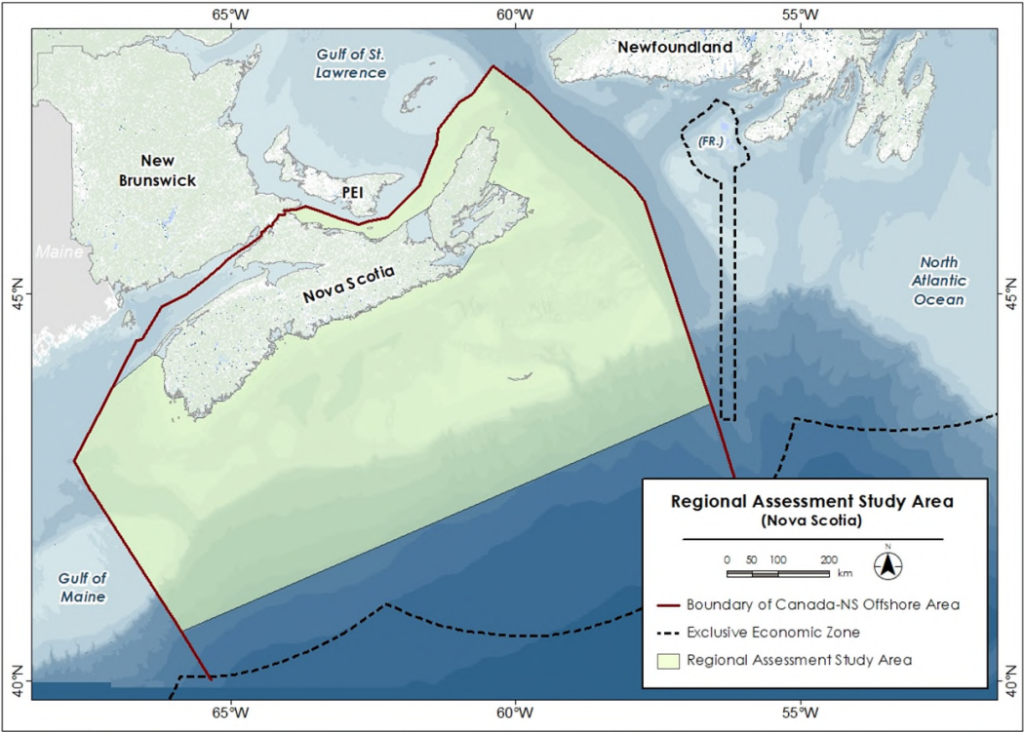
In March 2023, the governments of Canada and Nova Scotia appointed a five-member Regional Assessment (RA) Committee to evaluate offshore wind development in Nova Scotia. Their mandate is guided by the Impact Assessment Agency framework, the federal–provincial Agreement, and the published Terms of Reference. Canada.ca
The RA Committee was tasked with engaging extensively with Indigenous communities, ocean users (including fishers), conservation groups, industry stakeholders, academics, and the broader public to gather information and inform planning and assessment processes.
Final Report (January 23, 2025) –Eight (8) potential development areas were identified, divided into Tier 1 and Tier 2 classifications. A comprehensive set of recommendations for consideration by both Federal and provincial Ministers.
The Committee’s spatial planning process included:
– Elimination of restricted zones
– Evaluation of environmental, technical, and socioeconomic constraints
– Community and stakeholder consultation
– Recommendation of a precautionary 25-km coastal buffer, with limited exceptions. Government of Nova Scotia
Tier 1 areas
Best suited for immediate consideration as Wind Energy Areas (WEAs).
Tier 2 areas
Require further evaluation and were set aside for possible future consideration.
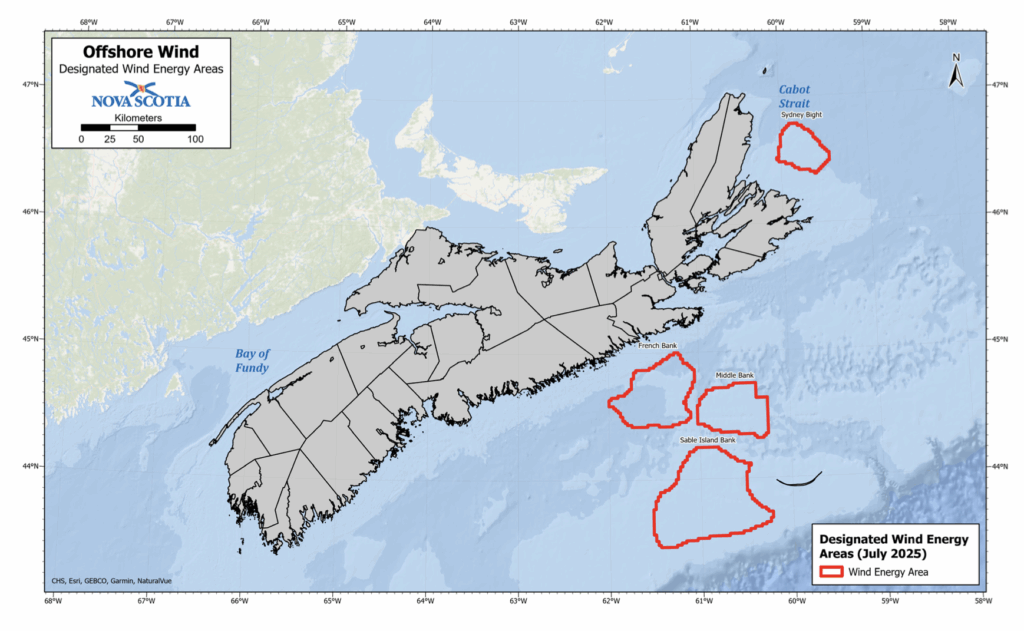
Following the RA Committee’s assessment, four Tier 1 areas—French Bank, Middle Bank, Sable Island Bank, and Sydney Bight—were formally designated as Canada’s first offshore Wind Energy Areas (WEAs). These designations, announced jointly by Canada and Nova Scotia, marked a significant step toward advancing offshore wind licensing.
Regional Assessment Study Area Map (Nova Scotia)
Regional Assessment Timeline

Notable Offshore Wind Events in Nova Scotia
April 2022 – Announcements by Canada, Newfoundland and Labrador, and Nova Scotia about intentions to expand the mandates of offshore boards to include offshore renewables.
April 2022 – Environment and Climate Change Canada announces the launch of a Regional Assessment (RA) for offshore wind development in Nova Scotia and Newfoundland and Labrador.
September 2022 – Nova Scotia sets a target to issue leases for 5 GW of offshore wind by 2030 in support of its emerging green hydrogen industry.
March 2023 – The Regional Assessments officially begin in both Nova Scotia and Newfoundland and Labrador.
May 2023 – Formation of the Nova Scotia Fisheries Alliance for Energy Engagement (NSFAEE), bringing together commercial fishing groups to coordinate engagement on offshore energy projects, advocate for science-based decision-making, and protect fishing grounds from poorly sited developments.
Summer – Fall 2023 – NSFAEE participates in early consultation sessions for the Regional Assessment process, pressing for transparent mapping of fishing effort, clear exclusion zones, and fisheries impact assessments as prerequisites for project approvals.
November 2023 – Nova Scotia government withdraws plans to fast-track offshore wind farm approvals, a move supported by NSFAEE as an opportunity for more thorough consultation and research.
October 2024 – Federal government passes Bill C-49, amending the Canada–Nova Scotia Offshore Petroleum Accord legislation to include offshore renewable energy and renaming the regulatory body to the Canada–Nova Scotia Offshore Energy Regulator.
Late 2024 – Early 2025 – NSFAEE submits formal recommendations to the provincial and federal governments on Wind Energy Area (WEA) selection, emphasizing the protection of high-value lobster grounds and migration corridors, and calling for a Renewable Effects Fund to address any proven negative impacts on fisheries.
May 2025 – Publication of the Dalhousie-led study “Views from the shore”, highlighting ambivalence among fishers, Indigenous groups, NGOs, and the public—echoing many of the concerns raised by NSFAEE around biodiversity and long-term ecosystem health.
July 2025 – Canada and Nova Scotia jointly designate Canada’s first four offshore WEAs—French Bank, Middle Bank, Sable Island Bank, and Sydney Bight. NSFAEE notes improvements in siting to avoid some key fishing grounds but continues to advocate for precautionary buffers and phased development.
Quick Facts: Offshore Wind in Nova Scotia
Regulatory Oversight
Offshore wind projects in Nova Scotia will be overseen by the existing offshore petroleum regulator—its mandate expanded and name changed to the Canada–Nova Scotia Offshore Energy Regulator—following the passage of Bill C-49 in October 2024.
Global Growth
In the last decade, offshore wind development has grown dramatically. Northern Europe led early adoption, with the UK, Denmark, and Germany as major players. More recently, China has become the fastest-growing market, installing over half of all new offshore wind capacity globally in recent years (AEGIR, 2023).
Provincial Energy Targets
Nova Scotia aims to achieve 80% renewable electricity by 2030 and net-zero greenhouse gas emissions by 2050, with offshore wind playing a central role in meeting these targets.
Wind Resource Strength
The province’s offshore areas, particularly along the Scotian Shelf, have some of the strongest and most consistent wind resources in North America, making them attractive for large-scale renewable generation.
Designated Wind Energy Areas (WEAs)
As of July 2025, four WEAs have been designated: French Bank, Middle Bank, Sable Island Bank, and Sydney Bight. These areas were selected following environmental and socio-economic assessments, though consultations continue on siting, buffers, and coexistence with fisheries.
Economic Potential
The 5 GW leasing target could attract billions in investment, create supply chain opportunities for Nova Scotian ports, shipyards, and manufacturing, and generate long-term operational jobs.
Technology Types
Offshore wind farms can use fixed-bottom turbines (anchored to the seabed in shallower waters) or floating turbines (for deeper waters, allowing access to wind resources farther offshore). Nova Scotia’s mixed bathymetry means both technologies could be deployed.
Environmental Considerations
Development requires careful study of potential impacts on marine ecosystems, migratory species, and fishing activities. Groups such as the Nova Scotia Fisheries Alliance for Energy Engagement (NSFAEE) advocate for robust baseline science, transparent mapping of fishing effort, and precautionary buffers.
First Project Timelines
Even with WEAs designated, project licensing, environmental assessments, and construction mean that the earliest operational offshore wind projects are expected in the early 2030s.
Green Hydrogen Potential
Hydrogen is a gas produced by splitting water molecules into hydrogen and oxygen. When created using renewable electricity, such as offshore wind, it is called green hydrogen. Nova Scotia’s 5 GW offshore wind leasing target is partly aimed at powering large-scale green hydrogen production for domestic use and export.